Why 95% of GenAI Pilots Fail — and Why the Most Adopted Enterprise AI Tech Likely Won’t Be “Agents”

The 95% Problem Isn’t a Model Problem. It’s an Operations Problem.
Recent MIT-affiliated research and industry reporting highlights a hard truth: despite massive investment, the majority of enterprise AI initiatives — particularly GenAI (generative AI), LLM, and “agentic” pilots — are not producing measurable return.
That shouldn’t surprise anyone who has watched the last two years unfold.
A large share of these pilots were launched in the easiest place to deploy AI: the office.
Documents. Email. Tickets. Notes. “Agentic” workflows that look incredible in a demo and promise to “change work forever.”
But most companies don’t become more profitable because they wrote faster meeting summaries or generated slightly better emails. And LLM-based reporting often struggles to create real confidence when outputs still require frequent verification due to hallucinations and ambiguity.
Organizations make money when the work that moves product, quality, safety, uptime, and throughput becomes measurable — and when the system producing that measurement can be trusted.
Why So Many GenAI Pilots Stall Out
Most GenAI deployments fail for a simple reason:
They’re probabilistic tools aimed at deterministic requirements.
In real operations, “mostly right” is often the same as wrong.
An executive doesn’t need an AI that can sound confident.
They need outputs that can survive audits, disputes, compliance checks, and the inevitable “prove it” moment.
That’s where generalized LLM workflows tend to collapse:
- They don’t naturally produce structured, verifiable evidence.
- They struggle with long-tail edge cases that are normal in the real world.
- They introduce new governance and security concerns.
- And they often become expensive in the exact way operations teams hate: quietly, over time.
None of this means LLMs aren’t useful. They are.
It means they are often being deployed as the engine in places where they should be a layer.
In operational contexts, the engine must be deterministic data capture and verification — with LLMs layered on top.
The AI That Actually Moves the Needle Has Been Here for Years
The biggest operational wins are not coming from “agents.”
They are coming from deterministic systems:
- object detection
- segmentation
- tracking
- sensor fusion
- event detection
- and the unglamorous part most pilots skip: software designed around a specific environment
These systems don’t “reason” about your business.
They take an input and produce a direct output.
That is why they scale.
Warehouses, distribution centers, production facilities, labs, and workshops all share the same reality: the problems are physical, time-bound, and measurable.
If you can capture the signal, you can change the business.
The Shift That’s Already Underway: Edge, On-Prem, and Clear Boundaries
As companies move from experimentation into production, priorities harden.
Security stops being a line item and becomes a design constraint.
Costs stop being “pilot tolerable” and become “multi-year operationally survivable.”
That’s why the next phase of enterprise AI is moving closer to the source of truth: the camera, the sensor, the facility, the production line.
Edge and on-prem deployments aren’t a nostalgia play.
They are a control play:
- control over data boundaries
- control over reliability
- control over long-term cost
- control over what the system is allowed to do
In operations, control is not optional — it is the entire point.
What This Looks Like in Practice
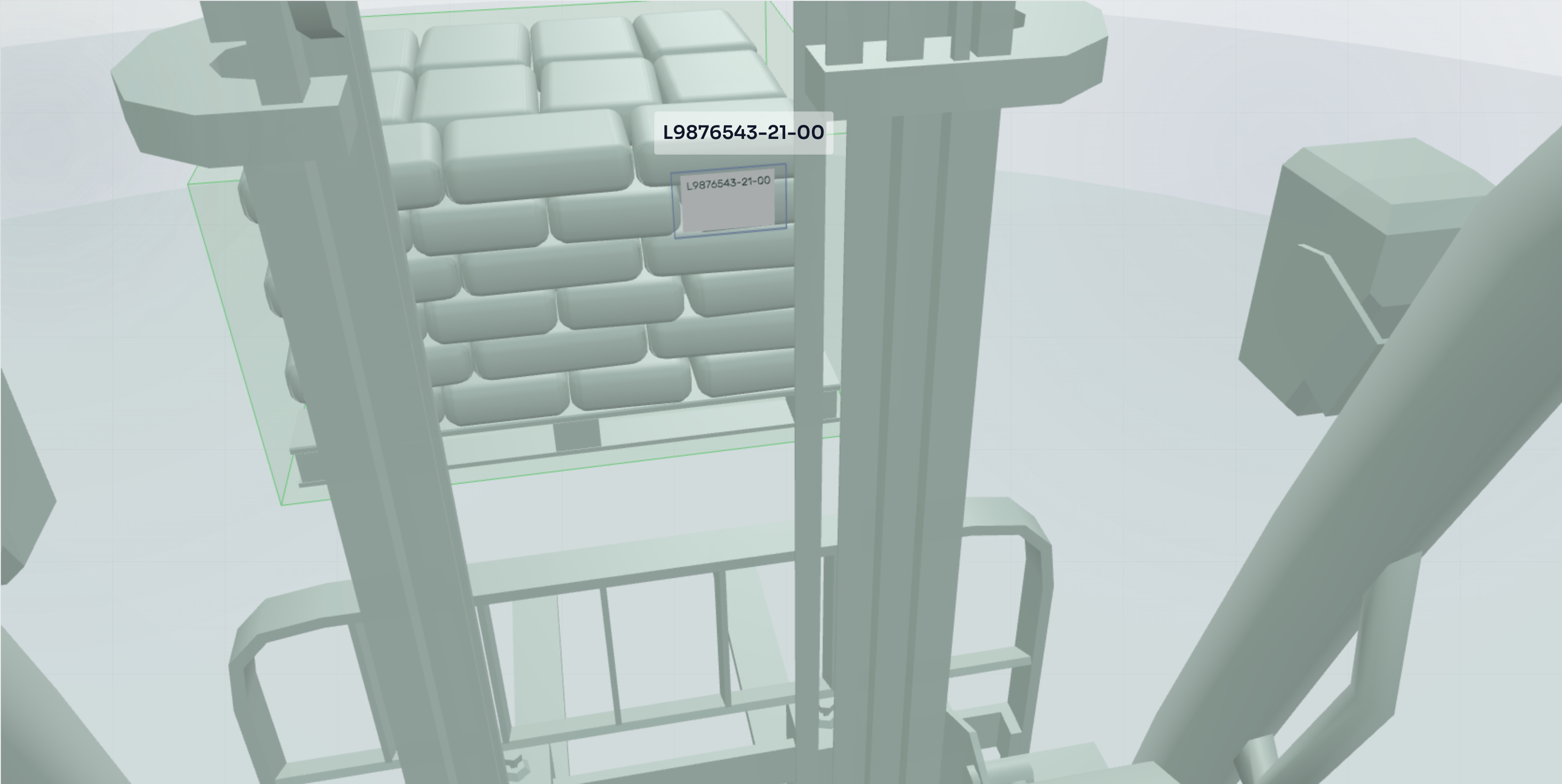
In practice, deterministic operational AI looks far less glamorous than most demos — and far more useful.
It means systems that automatically capture what happened, where, and when, directly at the point of work: when a pallet is wrapped, when custody changes, when damage occurs, when a process deviates from expectation. Those same systems then link that captured data back into the rest of the operational stack.
Not inferred later. Not reconstructed from memory. Captured as part of the operation itself.
Instead of teams debating incidents weeks later with partial data, they have timestamped, verifiable evidence produced in real time — evidence that can survive audits, claims, disputes, and internal scrutiny.
The outcome isn’t “insight” in the abstract.
It is fewer chargebacks. Faster resolution. Less internal finger-pointing. And fewer checks written defensively because the truth could not be proven.
This is where deterministic systems quietly pay for themselves — not through dashboards, but through problems that stop happening and questions that no longer need to be asked.
Where OSPR Fits
Our core belief is simple:
Businesses don’t need more AI experiments. They need operational truth.
Most AI conversations focus on models. In real operations, the model is rarely the hard part. The hard part is capturing clean, trustworthy data from environments that are physical, time-bound, and full of edge cases.

OSPR was built to address that layer.
We deploy deterministic systems directly inside production, distribution and lab environments — capturing video, sensor data, timestamps, and facility context — and convert those messy inputs into structured operational outputs: events, evidence, metadata, and integrations that other systems and teams can rely on.
Once that foundation exists, decisions get easier.
Exceptions become sharper.
Disputes become cheaper.
And automation becomes less of a leap of faith and more of a controlled upgrade.
This is the difference between AI as an experiment — and AI as infrastructure.
LLMs Have Their Place — and It Is Not Everywhere
LLMs can be part of that story. On-prem LLMs are part of what we provide our customers.
Used correctly, LLMs are powerful as an interface layer: summarizing events, generating reports, formatting text, and accelerating analysis. Their best work happens after the facts are already captured — not before.
An LLM should not be guessing what happened in your building.
It should be explaining what happened using evidence your systems already produced.
That is the difference between AI as theater and AI as infrastructure.
The Takeaway
The lesson from the last two years is not that “GenAI is over” or that “agentic AI is failing.” Even with a large percentage of initiatives stalling, the long-term outcome will land somewhere between hype-driven experimentation and disciplined operational deployment.
The real takeaway is that enterprises are relearning what production actually means.
Real business value comes from:
- deterministic outputs
- measurable workflows
- clear data boundaries
- and systems designed for operations, not demos
The narrative is shifting — not away from AI, but toward the AI that fits the real world.
Sources
- MIT / Project NANDA — State of AI in Business (2025)
https://mlq.ai/media/quarterly_decks/v0.1_State_of_AI_in_Business_2025_Report.pdf